

Hiring more reps and pushing them to dial faster used to be the advantage businesses had. That advantage doesn’t work anymore. A single AI voice interaction now costs a fraction of what a human call costs, and more enterprises have already brought some form of voice AI into their outbound process.
An AI voice agent not only handles volumes of calls but also holds a genuinely better conversation with the people you want to reach, at any hour, without getting tired.
This guide breaks down the top AI voice agent platforms for cold calling and a quick comparison across speed, pricing, latency, and ease of deployment.
What is an AI voice agent?
If you’ve been researching AI calling software, you’ve probably come across terms like AI voice agent, AI dialer, sales engagement platform and contact centre AI.
They’re often used interchangeably, even though they solve very different problems. Understanding the difference will help you narrow your shortlist much faster.
1. AI voice agent
An AI voice agent is software that can run an entire phone conversation without human intervention. It introduces itself, asks questions, listens to responses, answers follow-up questions and decides what to say next in real time.
This is the category we’ll focus on throughout this guide.
Also Read: A Learning Guide to AI Calling Agents and Their Benefits for SMBs
2. AI dialer
AI dialers help sales representatives place more calls by automating tasks like number selection, call routing and voicemail drops. The human sales representative still handles every conversation.
Examples: Orum, Nooks
3. Sales engagement platform
Sales engagement platforms help teams manage outbound sales across multiple channels such as phone, email and LinkedIn. They automate outreach, sequences and track engagement, but human sales representatives still lead conversations.
Examples: Outreach, Salesloft, Apollo
4. Contact centre AI
Contact centre AI platforms are designed primarily for customer support. They combine voice AI with features like call routing, IVR, workforce management, compliance and quality monitoring to handle high volumes of inbound customer conversations.
Examples: NICE CXone, Genesys Cloud CX, Five9
5. Voice chatbot
Voice chatbots are typically rule-based systems that follow predefined conversation flows. They work well for simple tasks such as checking an account balance or booking an appointment but often struggle when customers ask unexpected questions or change the direction of the conversation.
| Type | Who talks | Best for | Example |
| AI voice agent | AI, end-to-end | Outbound cold calling at scale | JoyzAI, Retell AI |
| AI dialer | Human rep | Increasing SDR call volume | Orum, Nooks |
| Sales engagement platform | Human rep | Managing multi-channel sequences | Outreach, Salesloft |
| Contact centre AI | Mixed / AI-assisted | High-volume inbound support | Five9, NICE CXone |
| Voice chatbot | AI, scripted only | Simple, narrow FAQ-style calls | Legacy IVR systems |
Can AI voice agents really replace cold calling?
Short answer: for a lot of cold calling, yes.
Modern AI voice agents can open a call naturally, explain what you’re offering, ask the right qualifying questions, handle common queries, book a meeting, and update the CRM afterwards, all without a person doing any of it.
And they can do this on hundreds of calls at once, all day, without ever needing a break.
But there are places where AI still struggles. If a conversation turns emotional, or the prospect brings up something unusual that has nothing to do with the pitch, weaker tools can fall apart quickly. Complex negotiations are still hard for AI to handle well.
Some prospects want to feel like they’re speaking to a real decision maker, and they can usually tell the difference. Language is another tricky spot.
A prospect who mixes Hindi and English in the same sentence, which happens all the time in India, can still confuse the weaker platforms out there.
That’s why certain conversations should always go to a human.
Think about price negotiations, custom proposals, or any queries that need real judgment instead of a scripted response.
If a prospect straight up asks to speak to a person, that’s a clear signal too.
The best way to think about AI here is as a filter. It qualifies leads and warms them up, so a human can step in and close the ones actually worth closing.
So when does AI genuinely beat a human sales rep? A great SDR will always win on judgment and on building real rapport. AI wins on the basics: consistency, timing, and speed.
An AI agent calls a fresh lead within minutes instead of days, and it never has an off day. That difference alone can be the gap between a lead that converts and one that goes cold.
Recommended article: AI Cold Calling: How Indian Businesses Are Automating Sales Outreach in 2026
Anatomy of a good AI voice agent
Every AI voice agent relies on the same core technologies. The difference between a conversation that feels natural and one that sounds robotic usually comes down to how well these components work together.
1. Speech recognition (STT)
Speech recognition, also known as Speech-to-Text (STT), converts a prospect’s spoken words into text that the AI can understand.
People answer calls from busy offices, moving vehicles and crowded public places. They interrupt themselves, change direction mid-sentence and often mix multiple languages in the same conversation. If the AI misunderstands what was said, every subsequent response is built on incorrect information.
When evaluating a platform, pay attention to how well it handles different accents, background noise and multilingual conversations, especially if your customers are based in India.
2. Large language model (LLM)
The large language model acts as the decision-making engine behind every conversation.
Instead of selecting a response from a predefined script, it analyses the customer’s intent, remembers what has already been discussed and generates an appropriate response in real time.
A capable LLM should be able to:
- Stay consistent throughout long conversations
- Remember information shared earlier in the call
- Handle unexpected questions without losing context
- Respond naturally instead of repeating scripted answers
This is one of the biggest differences between modern AI voice agents and traditional voice bots.
3. Voice generation (TTS)
Text-to-Speech (TTS) determines how the AI sounds.
Good voice generation isn’t just about clear pronunciation. It also controls pacing, pauses, emphasis and tone, all of which influence how natural the conversation feels.
The best platforms pronounce names correctly, adapt their speaking pace to the conversation and avoid the flat, monotonous delivery that immediately signals a synthetic voice.
4. Turn-taking & latency
This is really about timing. How fast does the AI reply once the prospect stops talking? Can someone interrupt it mid-sentence without the whole call breaking down?
And if they do interrupt, does the AI pick the thread back up smoothly, or does it restart and sound confused? Of everything on this list, this one decides how “real” a call actually feels.
5. Telephony infrastructure
Telephony infrastructure is the foundation that keeps every conversation running smoothly.
It determines how reliably calls connect, how many conversations the platform can manage simultaneously and how well the system performs across different countries and telecom networks.
This becomes particularly important for businesses operating in India. A platform optimised primarily for North American phone networks may struggle with local carriers, regional accents or multilingual conversations.
Reliable telephony infrastructure is rarely highlighted in product demos, but it has a significant impact on call quality, connection rates and the overall customer experience.
How we evaluated these AI voice agents
We looked at 11 factors when comparing these platforms, ranging from how natural the voice sounds to how transparent the pricing is. Here’s what each one means and why it matters.
| Factor | Why It Matters |
| Voice realism | Determines how convincing the conversation feels |
| Latency | Reduces awkward pauses that break the illusion of a real conversation |
| Interruption handling | Prospects interrupt constantly, and this is where weak platforms fall apart |
| Reasoning | Determines whether the AI can handle unexpected questions |
| Ease of setup | Matters most for non-technical teams without engineering resources |
| Human handoff | Required for any call that gets too complex for AI to close alone |
| CRM integration | Cuts out manual data entry after every call |
| Workflow automation | Moves qualified leads forward without manual work |
| Analytics | Shows what’s working so campaigns can improve over time |
| Scalability | Determines whether the platform grows with your call volume |
| Pricing transparency | Avoids surprise costs once you’re actually running campaigns |
8 Best AI voice agents for cold calling
Below is a closer look at eight platforms worth considering, ranging from fully bundled, ready-to-use agents to developer-first tools you build yourself. Some are built specifically for Indian businesses; others are pure infrastructure meant for engineering teams.
1. JoyzAI
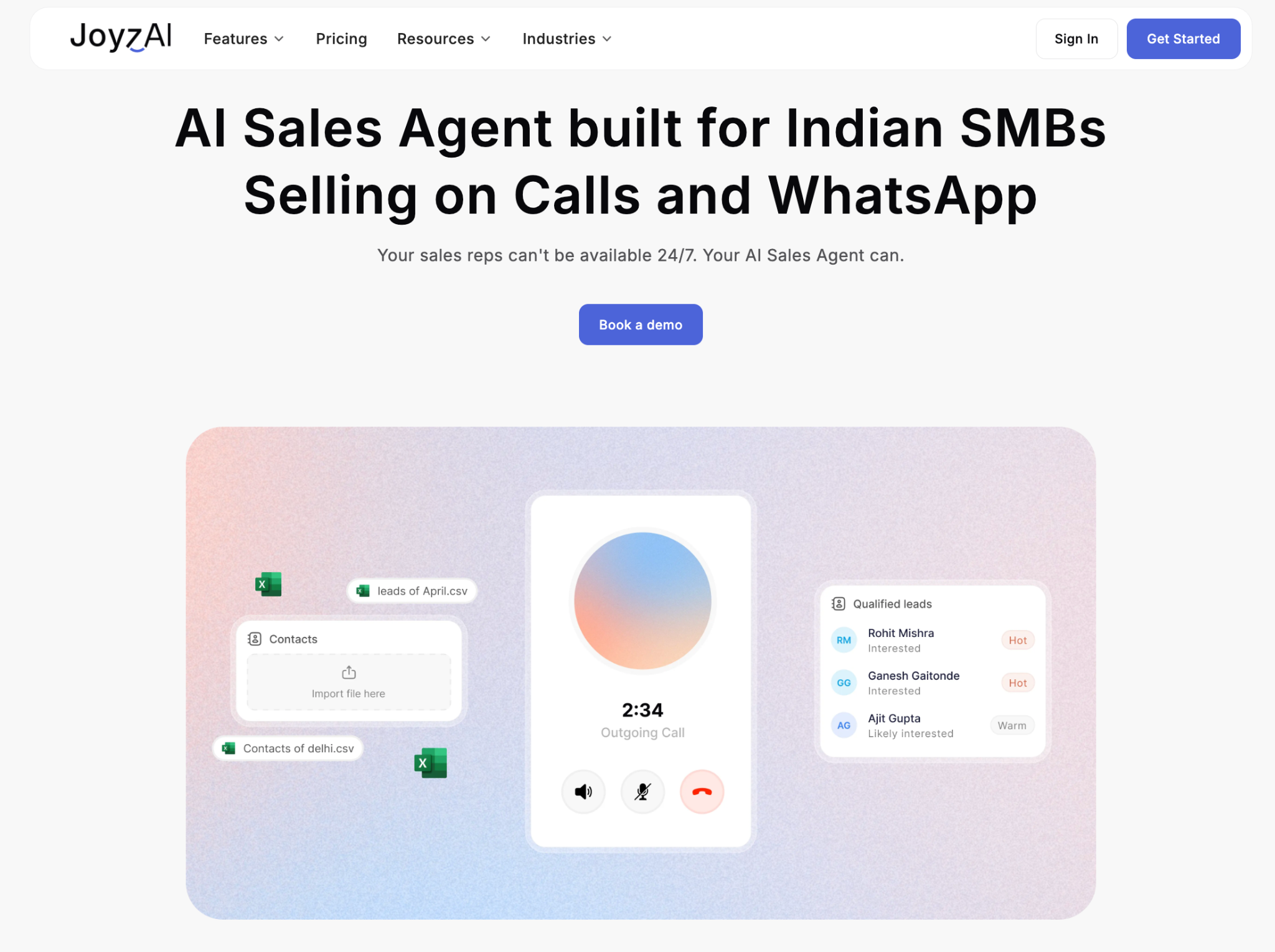
JoyzAI is an AI sales agent built for Indian SMBs that sell over phone calls and WhatsApp. Unlike most voice AI platforms that stop after the conversation, JoyzAI manages the entire sales workflow, from the first customer interaction to lead qualification, follow-ups and CRM updates, without requiring a developer.
The platform works across calls, WhatsApp, website chat and Instagram, allowing businesses to engage leads wherever they arrive. Every interaction automatically creates contacts, updates customer records, triggers workflows and follows up until the lead converts or drops out of the pipeline.
Its AI is designed specifically for Indian businesses, supporting natural conversations in English, Hindi and regional languages while understanding the code-switching common in everyday conversations.
Key Features
- AI sales agents for outbound and inbound calling
- Automatic lead qualification across calls and chat
- AI follow-ups on calls and WhatsApp until the deal is closed
- Unified inbox for calls, WhatsApp, website and Instagram
- Built-in CRM with contacts, conversation history and pipeline tracking
- Ticket management for customer requests and support issues
- Intent-based workflows that automate actions across business systems
- Call recordings, transcripts and AI-generated summaries
- Multilingual conversations in English, Hindi and regional languages
- Analytics dashboard for cold calling campaign, call and lead performance
Pros
- End-to-end sales platform that combines AI calling, CRM, WhatsApp and workflow automation in one system.
- Automatically qualifies leads and follows up across multiple channels without manual intervention.
- Unified inbox, contacts and ticketing eliminate the need for multiple tools.
Cons
- Less suitable for developers looking to build highly customised voice applications using their own AI models.
- Focused on sales automation rather than general-purpose conversational AI.
Pricing
- AI Calling: ₹6 per minute
- Business phone number: ₹1,100 per month
- One-time setup: ₹10,000
Best For
Indian SMBs looking for a complete AI sales platform that automates outbound sales calls, lead qualification, WhatsApp follow-ups, CRM updates and customer workflows without hiring developers or stitching together multiple tools.
Similar Read: Best AI Voice Phone Calling Agents in Hindi in 2026
2. Retell AI
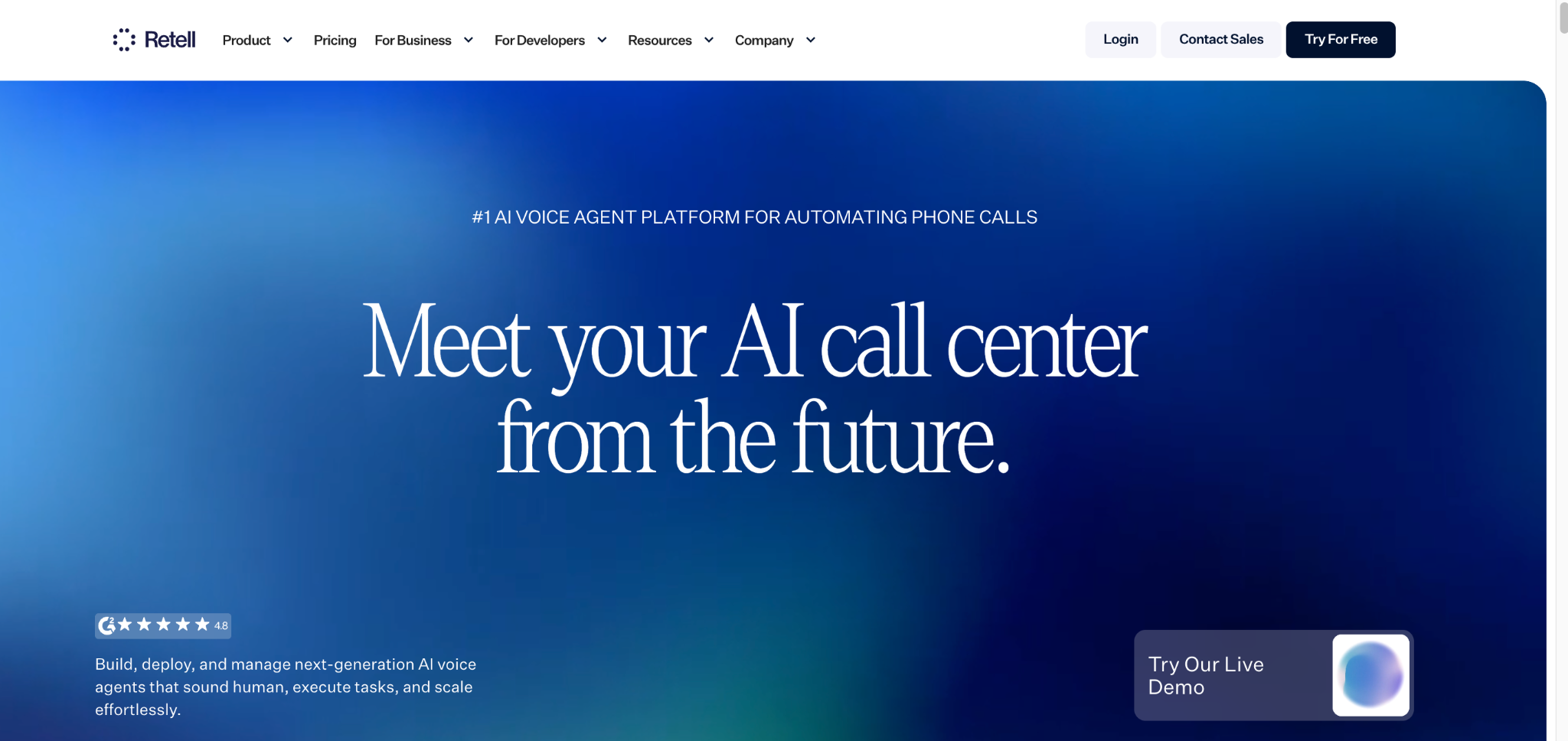
Retell AI is a voice AI platform for businesses that want to deploy human-like AI phone agents without building every component from scratch. It combines a configurable agent builder, enterprise telephony features and low-latency voice infrastructure into a single platform, making it suitable for both developer teams and enterprises deploying AI voice agents at scale.
The platform’s biggest differentiator is conversational quality. Its proprietary turn-taking model helps voice AI agents know when to speak, when to listen and how to handle interruptions naturally, allowing conversations to feel much closer to speaking with a human than a traditional IVR or rule-based voice bot.
Key Features
- AI voice agents for inbound and outbound conversations
- Proprietary turn-taking model for natural interruptions and dialogue flow
- Approximately 600 ms response latency
- Drag-and-drop agent builder with configurable conversation flows
- Built-in simulation testing for validating AI agents before deployment
- Batch calling and verified caller ID support
- Performance analytics and custom reporting dashboards
- Voice, chat, SMS and API support
- SIP trunking and telephony integrations
- Enterprise security with SOC 2 Type II, HIPAA and GDPR compliance
Pros
- Drag-and-drop builder makes it easier to launch without extensive engineering effort.
- Built-in testing and analytics help improve AI agent performance over time.
- Enterprise deployment options include SSO, role-based access control and on-premise infrastructure.
Cons
- Advanced customisations still require developer expertise.
- Workflow automation and CRM capabilities are less comprehensive than dedicated AI sales platforms.
Pricing:
The platform offers two types of plans
- Pay as you go: Starts at $0.07 to $0.31 per minute for AI voice agents, with $10 in free credits, simulation testing, analytics and support for up to 20 concurrent calls.
- Enterprise: Custom pricing with dedicated implementation support, SSO, enterprise infrastructure, role-based access control and higher concurrency limits.
Best For
Businesses and developer teams looking for a production-ready AI voice platform that combines natural conversations, low latency and enterprise deployment capabilities without building an entire voice stack from scratch.
3. Vapi AI
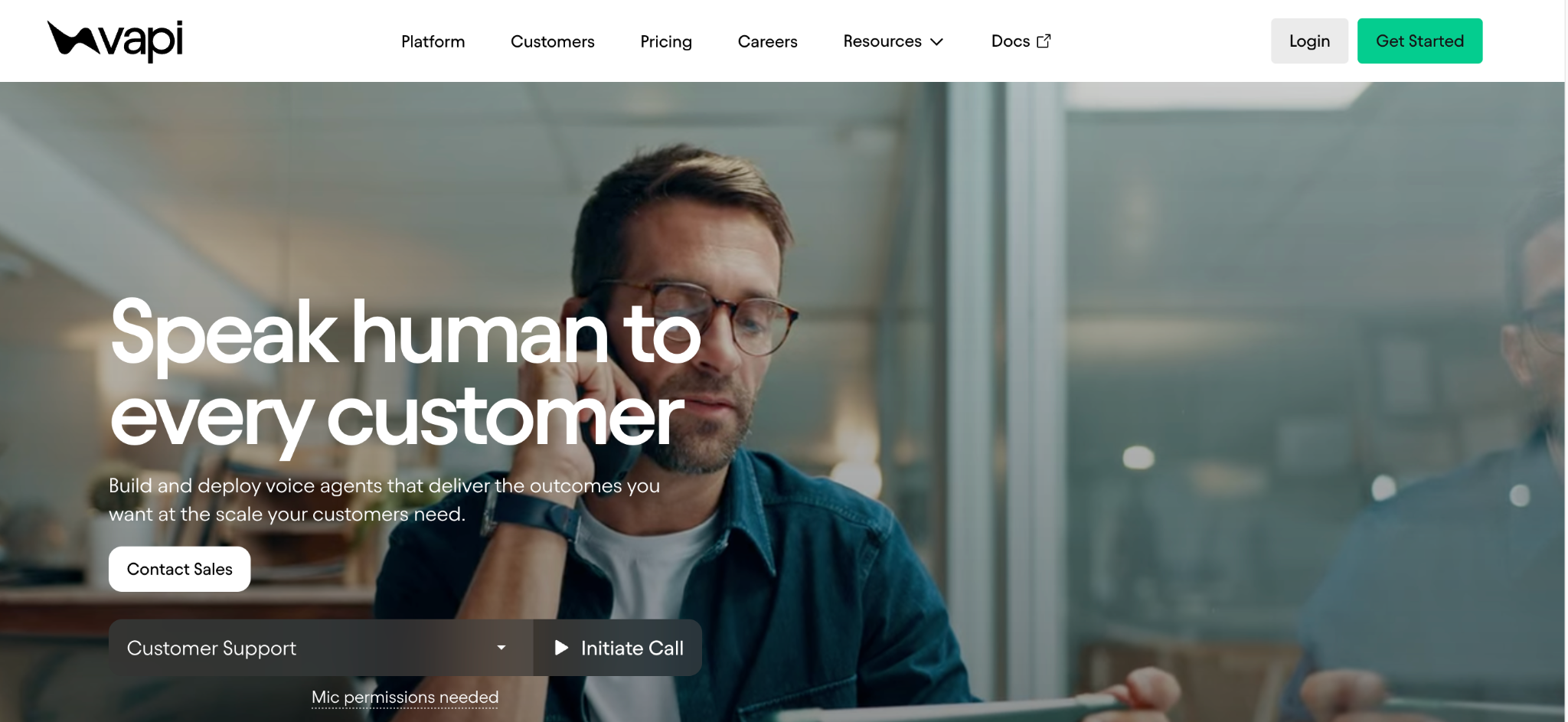
Vapi AI is an API-first platform for building and deploying production-ready AI voice agents. It gives developers complete control over every layer of the voice stack while also offering a visual interface for configuring and testing agents. Unlike platforms that lock you into a single AI model or voice provider, Vapi lets you mix and match more than 200 models, speech providers and integrations.
One of Vapi’s biggest strengths is flexibility. AI agents can access external data, trigger workflows, perform real actions during conversations and even hand customers between multiple specialised AI agents, making it well suited for complex production deployments.
Key Features
- API-first platform with a visual builder
- Support for 200+ AI models, speech providers and integrations
- Tool calling to retrieve data and perform actions during conversations
- Multi-agent orchestration with intelligent routing and handoffs
- Bring your own LLM, speech recognition and voice models
- Automated testing and A/B experiments for prompts, voices and workflows
- Reporting and analytics dashboards
- Model fallback and latency balancing across providers
- Enterprise security with SOC 2, HIPAA, PCI DSS, SSO and RBAC
Pros
- Works with hundreds of AI models and voice providers, reducing vendor lock-in.
- Automated testing and A/B experiments make it easier to optimise conversations before deployment.
- Enterprise-grade infrastructure scales to millions of calls with sub-500 ms response times.
Cons
- Advanced implementations still require engineering expertise.
- Better suited for custom voice applications than businesses looking for an out-of-the-box AI sales platform.
Pricing
The platform offers two types of plans:
- Build: Usage-based pricing with platform call charges, including 60+ free call minutes, custom voice support and access to 200+ AI models. Additional model costs are billed separately.
- Scale: Custom annual contracts with committed usage, enterprise security, priority infrastructure, dedicated account management and volume-based pricing.
Best For
Engineering teams and enterprises building production-grade AI voice applications that require maximum flexibility, deep integrations and complete control over their AI infrastructure.
4. Bland AI
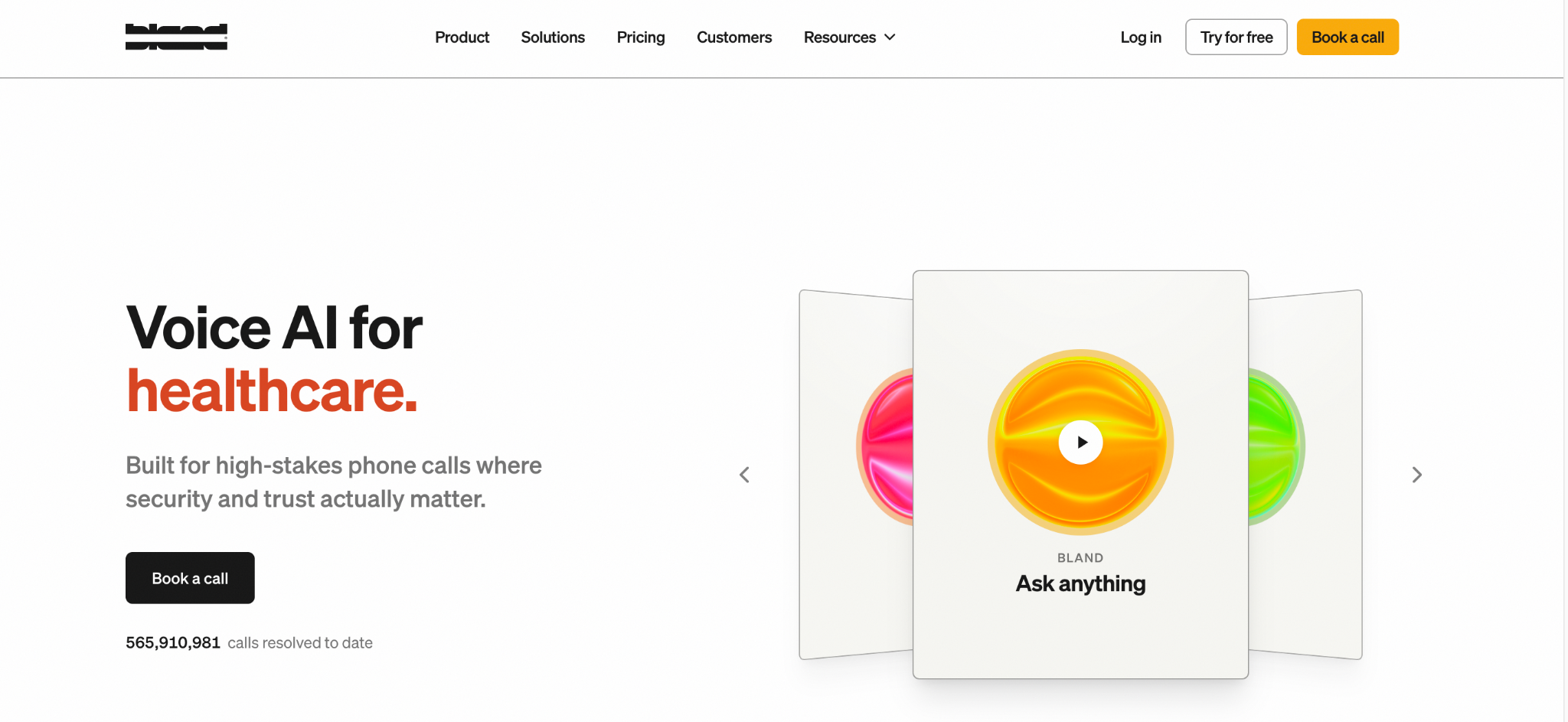
Bland AI is a developer-focused platform for building and deploying AI voice agents at scale. While it originally catered primarily to engineering teams, the platform now also includes Norm, a natural language builder that lets non-technical users create production-ready AI agents by simply describing what they want to build.
Beyond voice conversations, Bland AI supports omnichannel deployments across voice, SMS, iMessage and web chat, with unified memory that preserves conversation context across every channel. The platform also includes enterprise testing, observability and compliance features, making it suitable for organisations deploying AI agents in production.
Key Features
- Customisable voice AI for inbound and outbound conversations
- Omnichannel deployment across voice, SMS, iMessage and web chat
- Unified memory across all customer interactions
- Enterprise testing environment for validating edge cases before deployment
- Real-time call monitoring and observability
- CRM, telephony and scheduling integrations
- Warm transfers to human agents
- Enterprise security with SOC 2 Type II, HIPAA, GDPR and PCI DSS compliance
Pros
- Supports production deployments with built-in testing and real-time monitoring.
- Omnichannel memory keeps conversations consistent across multiple customer touchpoints.
- Flexible integrations with existing telephony, CRM and scheduling platforms.
Cons
- Advanced customisation still benefits from technical expertise.
- Better suited for businesses building custom AI workflows than teams looking for an out-of-the-box sales platform.
Pricing:
The platform offers four different plans;
- Start: No platform fee, $0.14/minute, includes 10 concurrent calls, 100 calls/day, one voice clone and ten knowledge bases.
- Build: $299/month platform fee plus $0.12/minute, supports 50 concurrent calls and 2,000 calls/day.
- Scale: $499/month platform fee plus $0.11/minute, supports 100 concurrent calls and 5,000 calls/day.
- Enterprise: Custom pricing with dedicated infrastructure, VPC or on-premise deployment, SSO, data residency and forward-deployed engineering support.
Best For
Engineering teams and enterprises that want a highly customisable AI voice platform with enterprise-grade testing, observability, omnichannel deployment and flexible integrations.
5. ElevenLabs Conversational AI
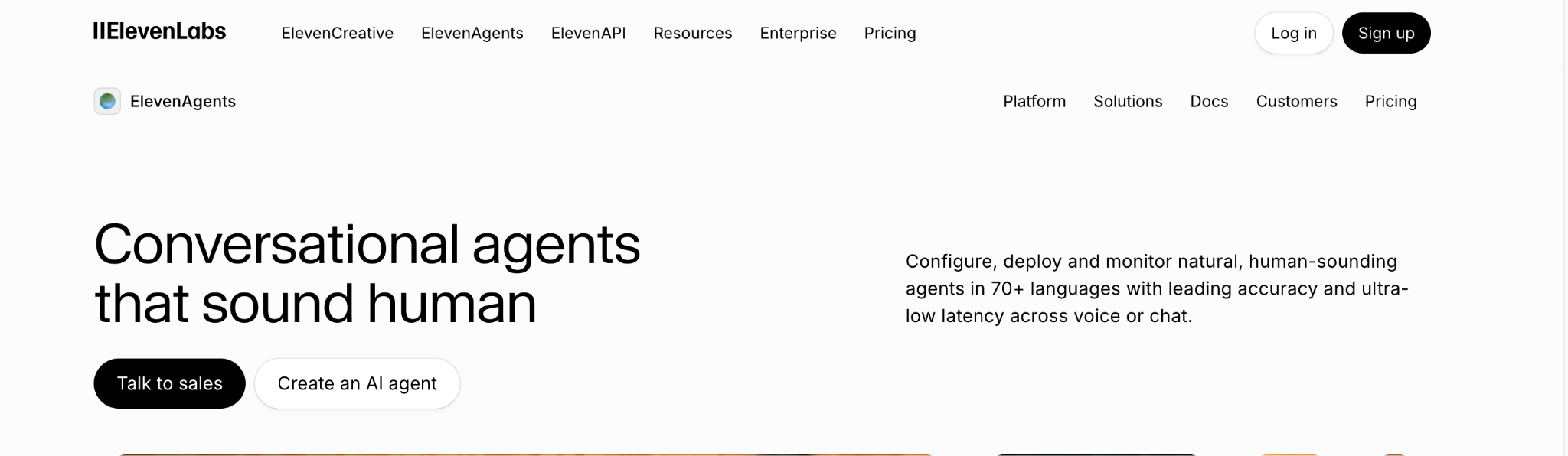
ElevenLabs started as the company behind some of the world’s most realistic AI voices. Today, its Conversational AI platform lets businesses build AI agents that can answer calls, qualify leads, book meetings and update CRM records using the same speech technology.
Voice quality remains its biggest differentiator. The platform combines expressive, human-like speech with ultra-low-latency conversations, real-time data access and support for multiple communication channels. While developer-friendly, it’s also built for production deployments where reliability, security and customer experience matter.
Key Features
- AI voice agents for inbound and outbound conversations
- Industry-leading voice generation with natural emotion
- Ultra-low latency for real-time conversations
- CRM integrations with real-time data retrieval and updates
- Multi-channel deployment across phone, web, chat and messaging
- Support for more than 70 languages with dynamic language switching
- Persona and tone controls for different customer scenarios
- Enterprise security with SOC 2, HIPAA and GDPR compliance
Pros
- Supports multilingual conversations across more than 70 languages.
- Allows businesses to create custom brand voices through voice cloning.
- Works across multiple customer communication channels from a single AI agent.
Cons
- Building highly customised workflows still requires technical expertise.
- More suitable for businesses prioritising conversational quality than teams looking for an out-of-the-box sales platform.
Pricing
Paid plans start at $6 per month, with additional usage-based pricing depending on voice generation, AI agent usage and call volume.
Best For
Businesses that prioritise natural, human-like conversations and want to build multilingual AI voice agents for customer engagement, sales or support without compromising on voice quality.
6. Poly AI
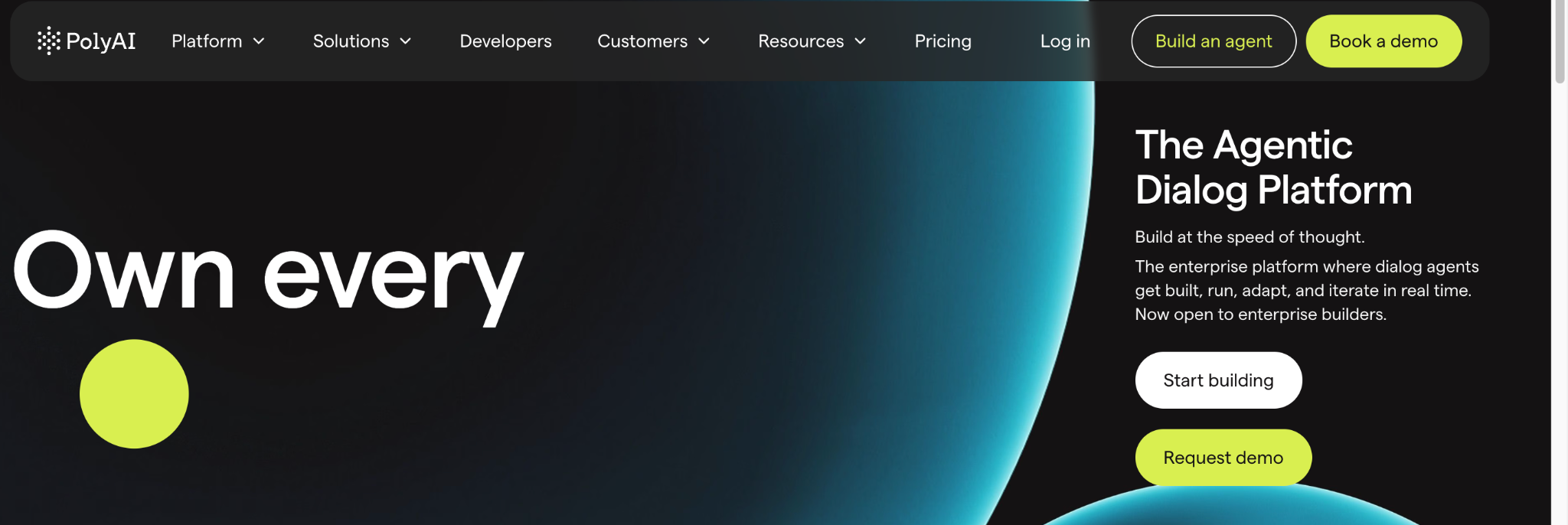
PolyAI is an enterprise conversational AI platform designed for organisations building AI agents for customer engagement at scale. Rather than focusing only on voice calls, it provides a full-stack dialogue platform powered by Raven, its proprietary conversational model trained on more than one billion enterprise conversations.
The platform supports two ways to build AI agents. Non-technical teams can use the Poly Agent Builder, while developers can build custom experiences using the Agent Development Kit (ADK). Both run on the same dialogue engine, making it easier for businesses to choose the level of customisation they need.
Key Features
- Proprietary Raven dialogue model trained on 1B+ enterprise conversations
- Poly Agent Builder for no-code AI agent creation
- Agent Development Kit (ADK) for developers
- Full-stack dialogue platform built for enterprise customer engagement
- Enterprise governance and guardrails for compliance and brand consistency
- Support for multilingual conversations across voice and digital channels
- Integrations with enterprise contact centre platforms
Pros
- Purpose-built dialogue engine designed for complex enterprise conversations.
- Strong governance features help maintain brand consistency across every interaction.
- Enterprise-grade security and compliance, including SOC 2, HIPAA, GDPR and PCI DSS.
Cons
- Enterprise-focused platform that may be excessive for small and mid-sized businesses.
- Better suited for enterprise customer engagement than rapid deployment for SMB outbound sales.
Pricing :
Custom enterprise pricing.
Best For:
Large enterprises looking for a secure, enterprise-grade conversational AI platform with proprietary dialogue models, flexible development options and strong governance for customer engagement across multiple channels.
7. SquadStack
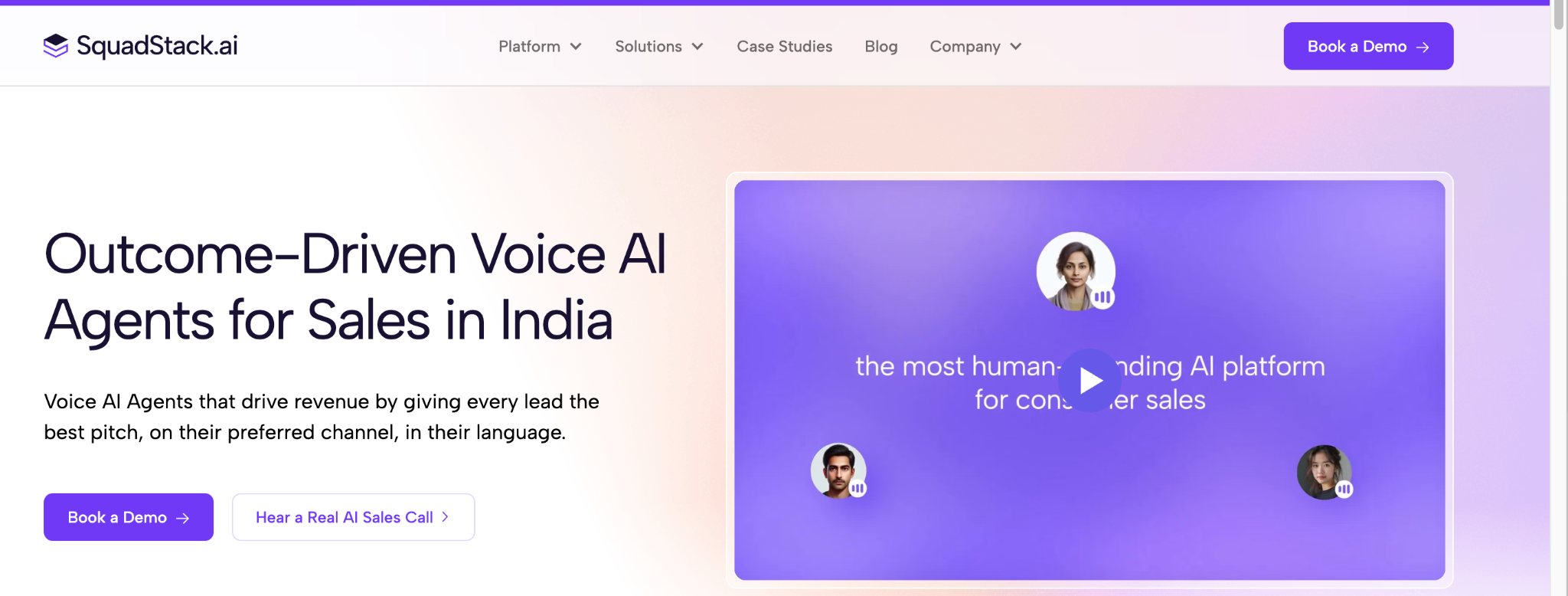
SquadStack is an enterprise AI sales platform built for businesses selling to customers over the phone in India. Unlike many AI voice platforms that focus only on conversations, SquadStack is designed to improve conversion rates across the sales funnel by combining proprietary voice AI, multilingual speech models and workflow automation.
One of its biggest differentiators is its focus on Indian customer conversations. The platform’s speech models are trained on more than 600 million minutes of real Indian contact centre conversations, allowing it to understand Hindi, Hinglish, Tanglish and other regional language variations more naturally than many global AI voice platforms.
Key Features
- AI voice agents for inbound and outbound sales
- Proprietary speech models trained on 600M+ minutes of Indian conversations
- Native support for Hindi, Hinglish and regional languages
- Cross-channel memory across voice, WhatsApp, SMS and in-app conversations
- Built-in A/B testing for prompts, voices, workflows and channel sequencing
- Long-context conversations with support for complex multi-turn sales calls
- CRM integrations and workflow automation
- Enterprise-grade compliance including ISO 27001, ISO 27701, SOC 2 Type II, DPDP and TRAI compliance
Pros
- Built specifically for Indian sales teams and customer behaviour.
- Excellent multilingual understanding powered by proprietary Indian speech models.
- Supports long, natural conversations without losing context.
- Cross-channel memory enables more personalised customer interactions.
- Built-in experimentation tools make it easier to optimise AI sales campaigns over time.
- Strong compliance credentials for enterprise deployments.
Cons
- Enterprise-focused platform that may be more than smaller businesses require.
- Less suited to developer teams looking for low-level APIs and custom voice application development.
Pricing
Custom enterprise pricing.
Best For
Large Indian businesses looking for an enterprise AI sales platform that combines voice AI, multilingual conversations, workflow automation and cross-channel customer engagement to improve sales performance at scale.
8. Synthflow AI
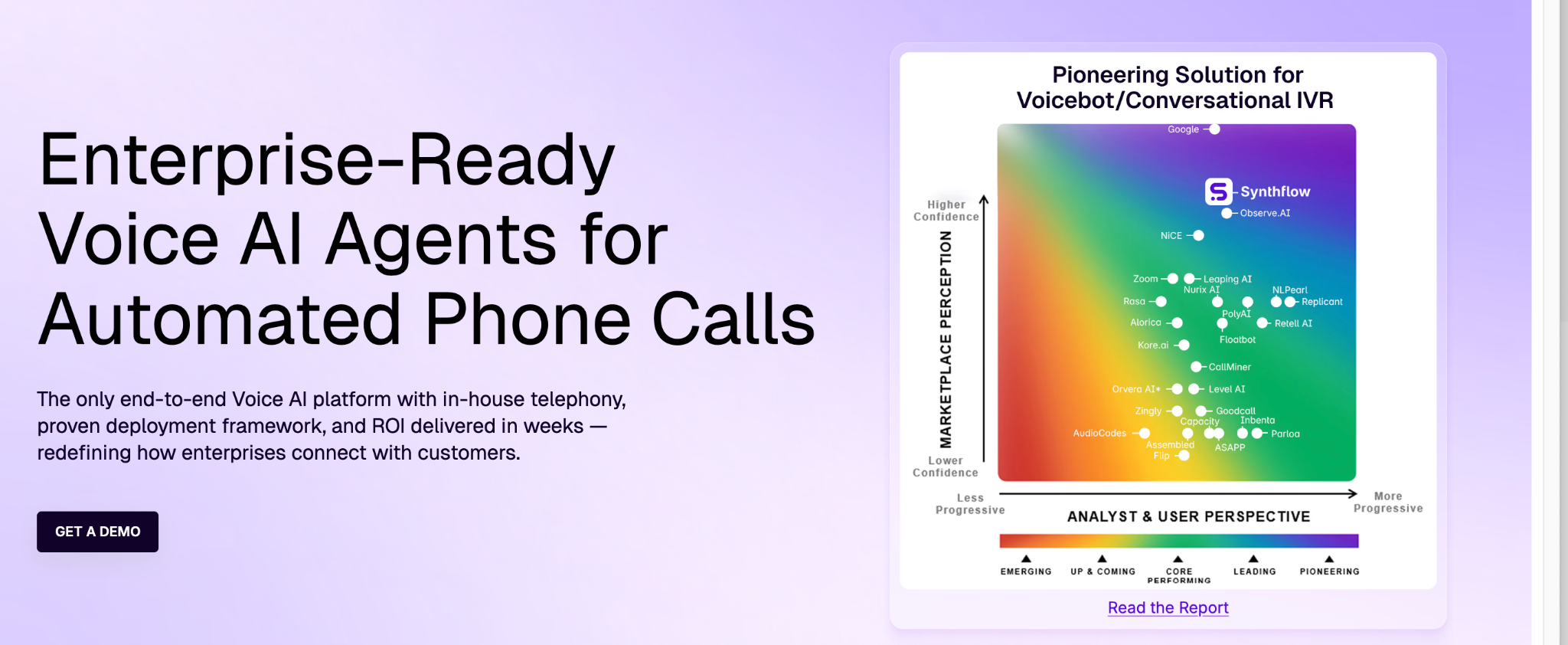
Synthflow AI is an enterprise-focused conversational AI platform that helps businesses automate customer interactions across voice, chat and SMS. Unlike developer-first platforms that require multiple providers for telephony and deployment, Synthflow combines AI voice agents with its own telephony infrastructure, allowing businesses to deploy production-ready voice agents without building the underlying stack themselves.
The platform is designed for enterprises looking to automate sales, customer support and appointment booking while maintaining reliability, low latency and compliance.
Key Features
- Enterprise AI voice agents for inbound and outbound calling
- Proprietary telephony infrastructure with sub-100 ms latency
- Omnichannel support across voice, chat and SMS
- No-code AI agent builder
- Human handoff and workflow automation
- CRM and business application integrations
- Enterprise deployment framework
Pros
- Built-in telephony removes the need for a separate calling provider.
- Supports voice, chat and SMS from a single platform.
- Enterprise-grade infrastructure designed for large-scale deployments.
- Low-latency conversations improve the natural flow of calls.
Cons
- Primarily designed for enterprise use cases, making it more than many SMBs require.
- Less suitable for developer teams looking for complete API-level customisation.
Pricing
Custom enterprise pricing. Contact Synthflow AI for a quote.
Best For
Enterprises looking for an end-to-end conversational AI platform with built-in telephony, omnichannel support and enterprise deployment capabilities, without managing multiple vendors or communication infrastructure.
Similar recommendation: Best AI Cold Calling Software in 2026: 10 Tools Compared
Quick comparison of the best AI Voice Agents for Cold Calling
Here’s the whole list side by side, so you can scan it in one go before reading the details above again.
| Platform | Voice Realism | Interruption Handling | Custom AI Model Support | Multilingual Support | Human Transfer | Pricing | Best For |
| JoyzAI | High (Indian-tuned) | Strong | No | Yes (English, Hindi & regional languages) | Yes | ₹6/min + ₹1,100/month phone number + ₹10,000 setup | Indian SMBs |
| Retell AI | High | Strong | Yes (bring your own models) | Via setup | Yes | $0.07–$0.31/min (usage-based) | Developer teams |
| Vapi AI | High | Strong | Yes | Yes (100+ languages) | Yes | Usage-based (60+ free mins, provider costs extra) | Developers & enterprises |
| Bland AI | High | Strong | Yes | Yes | Yes (Warm Transfer) | $0.14/min (Start), $0.12/min (Build), $0.11/min (Scale) + platform fee | Engineering teams & enterprises |
| ElevenLabs Conversational AI | Very High | Strong | Yes | Yes (70+ languages) | Yes | From $5/month + usage | Businesses prioritising voice quality |
| PolyAI | Very High | Excellent | No (Platform-managed) | Yes | Yes | Custom enterprise pricing | Large enterprises |
| SquadStack AI | High (Indian-tuned) | Strong | No (Platform-managed) | Yes (Hindi, Hinglish & regional languages) | Yes | Custom pricing | Indian enterprises |
| Synthflow AI | High | Strong | Yes | Yes | Yes | From $29/month + usage | SMBs & agencies |
Things most businesses forget to evaluate
Comparing AI voice agents is easy when you’re looking at feature lists. Almost every platform claims natural conversations, CRM integrations and human-like voices. The differences usually become apparent after deployment.
These are the factors buyers often overlook, even though they have a significant impact on day-to-day performance.
1. Call recordings
Every platform records calls. The real question is whether you can actually learn from them. Look for searchable transcripts, keyword search and filters that help you review hundreds or thousands of conversations without listening to every recording manually.
2. Prompt versioning
A good platform should let you test new prompts, compare their performance and revert to previous versions if a change reduces conversion rates. Without version control, improving your AI becomes guesswork.
3. CRM integration
Some platforms simply log that a call took place. Others update contact records, save transcripts, create new opportunities and trigger the next step in your sales process automatically.
That difference can eliminate hours of manual work every week.
4. Workflow automation
Check whether your platform can automatically assign leads, schedule follow-ups, create tasks, send WhatsApp messages or trigger email sequences once a conversation ends.
5. Analytics
Look for insights that help you improve performance, such as qualification rates, common queries, call drop-off points and campaign-level conversion metrics.
6. Human handoff
Evaluate how smoothly the platform transfers calls to a sales representative when required. A handoff that interrupts the conversation creates a poor customer experience and often results in lost opportunities.
7. Compliance
Compliance becomes increasingly important in regulated industries such as banking, financial services and healthcare.
Features like consent management, call recording disclosures and Do Not Disturb (DND) screening should be built into your outbound calling process rather than treated as an afterthought.
8. Multilingual support
The real test is whether an AI agent can handle natural conversations in the languages your customers actually speak, be it English, Hindi, or any regional language.
9. Telephony costs
Developer-first platforms typically require a separate telephony provider such as Twilio, Exotel or Plivo. Those costs are rarely included in the advertised pricing, so factor them into your budget before comparing platforms.
Build vs. Buy: Which type of AI voice agent is right for you?
Some organisations want complete control over every part of the conversation. Others simply want to launch campaigns quickly without building and maintaining their own infrastructure.
The right choice depends largely on your technical resources and business goals.
1. Choose a developer-first platform if:
A developer-first platform is the right fit if you:
- Have an engineering team that can build and maintain custom workflows
- Need complete control over prompts, conversation logic and integrations
- Are building your own AI voice product or embedding voice AI into an existing application
Platforms to consider: Retell AI, Vapi AI and Bland AI.
2. Choose a ready-to-use platform if:
A bundled platform makes more sense if you:
- Want to launch AI calling campaigns quickly
- Don’t have engineers managing multiple AI and telephony providers
- Need CRM integration, workflow automation, analytics and customer communication tools included in one platform
Platforms to consider: JoyzAI, Lindy and SquadStack.
If voice quality is your highest priority, ElevenLabs Conversational AI is one of the strongest options available.
If you’re building enterprise-grade customer support for large contact centres, PolyAI specialises in high-volume inbound voice automation and is worth evaluating separately.
Compliance essentials
Before you launch any outbound AI calling campaign, there are a few boxes worth checking so you don’t run into legal or trust problems down the line.
1. Consent
Make sure you can demonstrate when and how a customer consented to receiving phone calls, particularly if you operate in regulated industries.
2. Do Not Disturb (DND)
If you’re calling customers in India, screen your contact database against the TRAI National Do Not Disturb (NDNC/DND) registry before starting an outbound campaign.
3. Recording Disclosure
Many regions require businesses to inform customers when calls are being recorded.
Review the requirements that apply to your target market and ensure your AI agent handles these disclosures appropriately.
4. Human Escalation
Customers should always have the option to speak with a human representative when the conversation requires judgment, negotiation or additional support.
5. Data Retention
Understand where your provider stores call recordings, transcripts and customer information, how long the data is retained and whether it complies with your organisation’s security and privacy requirements.
Final Thoughts
Don’t choose an AI voice agent based on voice quality alone. The platforms in this guide range from raw conversational realism (ElevenLabs, PolyAI) to deep infrastructure control (Bland, Retell, Vapi) to fully bundled, ready-to-deploy sales agents (JoyzAI, Lindy, SquadStack). The right one depends entirely on what you’re actually trying to solve.
Look at conversation quality, automation, and how the platform fits your real sales workflow, not just how good it looks in a demo. Developer-first platforms give you the most flexibility, but they need engineers to set up and maintain. Ready-made platforms trade away some of that customisation for a much simpler launch, which matters most if you need to be live this week, not this quarter.
Choose based on your team’s technical ability and your sales process, not just the price tag.
If you’re an Indian SMB looking for a voice agent that combines natural conversation, real regional language support, and built-in WhatsApp and CRM automation, JoyzAI is worth exploring.
FAQs: Best AI Voice Agents for Cold Calling
1. What is the best AI voice agent for cold calling?
The best AI voice agent depends on what you’re trying to solve. Businesses looking for a ready-to-use sales platform can consider JoyzAI, while teams that need deeper control over voice infrastructure may prefer developer platforms such as Retell AI, Vapi AI, or Bland AI. If voice quality is the priority, ElevenLabs Conversational AI is another strong option. The right choice ultimately depends on call volume, integrations, customization, pricing, and how much technical support your team needs.
2. Can AI voice agents make outbound cold calls?
Yes. AI voice agents can make automated outbound calls, hold natural conversations, ask qualification questions, answer common objections, qualify prospects, and book meetings. Unlike an AI dialer, which mainly helps human sales reps increase their call volume, an AI voice agent can handle the conversation itself. This makes it useful for cold outreach, lead qualification, re-engagement campaigns, and other outbound sales workflows.
3. Can AI voice agents replace human sales reps?
AI voice agents can automate a significant part of the repetitive work handled by sales reps, but they shouldn’t be treated as a complete replacement for human sales teams. AI is well suited for initial qualification, follow-ups, appointment booking, common questions, and high-volume outreach. Human reps are still better suited for complex objections, negotiations, relationship building, and closing high-value deals. The strongest setup combines AI automation with human handoff when a conversation requires judgment.
4. Can AI voice agents qualify leads and book meetings?
Yes. An AI voice agent can ask predefined qualification questions, understand the prospect’s responses, identify buying intent, and determine whether a lead meets your criteria. If the prospect is qualified, the agent can check the sales calendar and schedule an appointment automatically. This turns the first call into more than just cold outreach—it can move a qualified prospect directly into the next stage of the sales pipeline.
5. Can AI voice agents integrate with existing CRM systems?
Most modern AI voice platforms support integrations with CRM systems, calendars, telephony providers, and other sales tools. Depending on the platform, the agent can automatically update contact information, record call outcomes, add conversation notes, trigger follow-ups, and create tasks after a call. Seamless integration is particularly important for businesses running multiple outreach campaigns because it keeps the sales pipeline updated without requiring reps to manually log every conversation.
6. Do AI voice agents support multiple languages?
Many AI voice agents support multiple languages and regional accents, although the level of multilingual support varies between platforms. For businesses operating across India, this can be particularly important because customers may switch between English, Hindi, and regional languages during the same conversation. When comparing platforms, test how well the agent handles language switching, accents, interruptions, and natural speech rather than simply checking the number of languages listed on the website.
7. When should an AI voice agent transfer a call to a human?
A human handoff makes sense when the conversation requires judgment that the AI shouldn’t handle independently. This can include complex objections, pricing negotiations, custom requirements, sensitive customer situations, or a prospect simply asking to speak with a person. A good AI voice agent should transfer the call without losing conversation context, so the human rep knows what has already been discussed instead of making the prospect repeat everything.